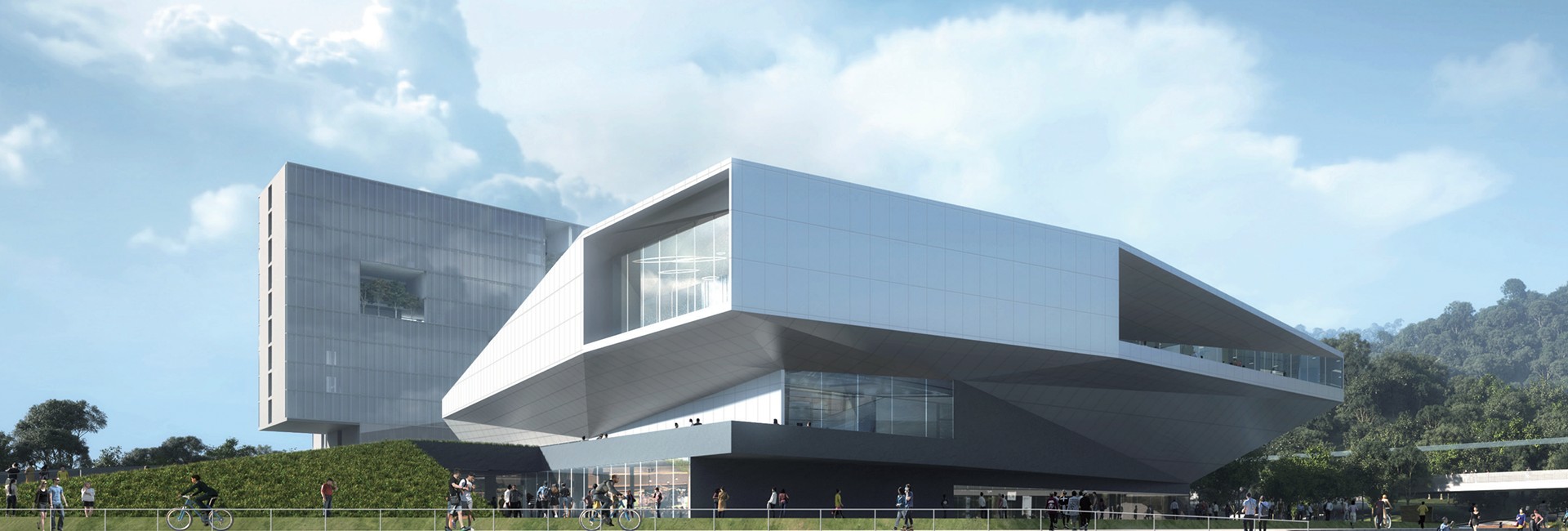
Academician Visits
On October 21,Foreign Academician of the Russian Academy of Sciences, Professor at Lomonosov Moscow State University, and Chief Researcher at the Institute of Complex Systems Mathematical Research Askar Akaev visited Shenzhen University of Advanced Technology (SUAT), delivering a lecture themed"Digital Economy, Mathematical Models, and Forecasting"to SUAT students. SUAT Party Secretary Zhu Dijian hosted the lecture and delivered a speech.
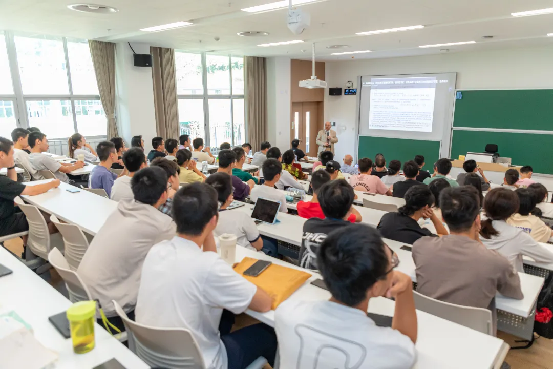
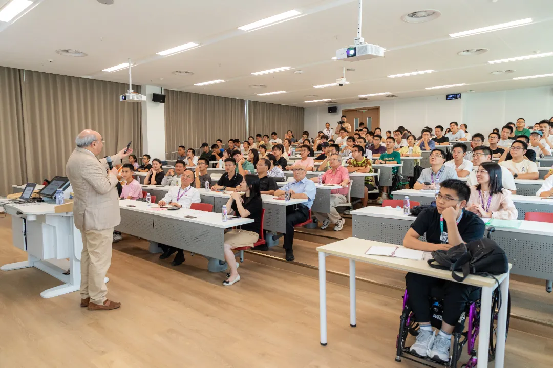
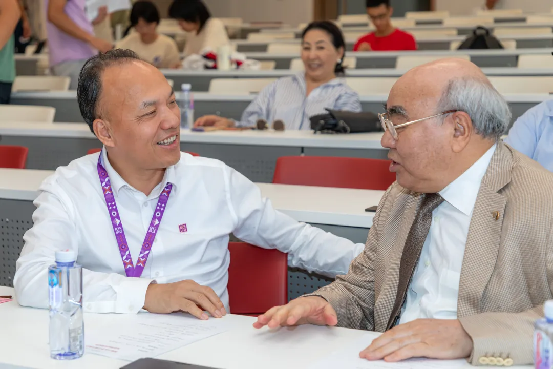
With his profound mathematical foundation and rich practical experience, Professor Akaev provided an in-depth analysis of the impact and transformation of the digital economy on traditional economic models, particularly emphasizing the key role of mathematical models in forecasting future trends in the digital economy. He pointed out—
By establishing scientific mathematical models, we can deeply mine and analyze data in the digital economy, thereby revealing the patterns and trends hidden behind the data.

Professor Akaev also shared
his latest achievements in the field of complex systems mathematics research
↓↓↓
He introduced a mathematical model based on complex network theory that can accurately predict market fluctuations and risk propagation in the digital economy. Through this model, we can gain a deeper understanding of the complexity and dynamics of the digital economic system, providing a scientific basis for formulating effective risk prevention and control strategies.
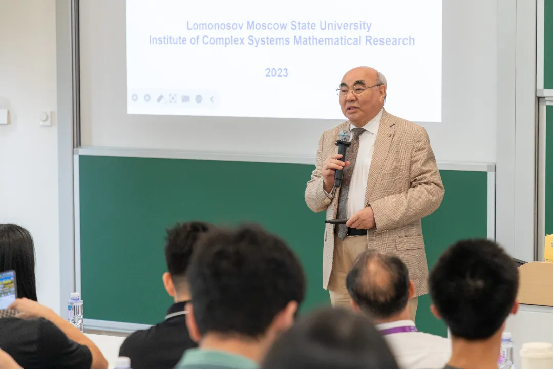

"Its small error and concise mathematical form made me once again appreciate the greatness of the Euler-Lagrange equation. " After listening to Professor Akaev's introduction on using mathematical models to accurately predict the macroeconomy, first-year undergraduate student Li Honghao could not help but exclaim, "In the field of physics, the trajectory of objects can be predicted through it; I never expected it to have applications in the digital economy as well. At the same time, the quantitative description role played by mathematics behind complex macroeconomic issues not only broadens our horizons but also makes us realize the future importance and unlimited potential of digital technologies such as microelectronics information technology, computers, and artificial intelligence. "
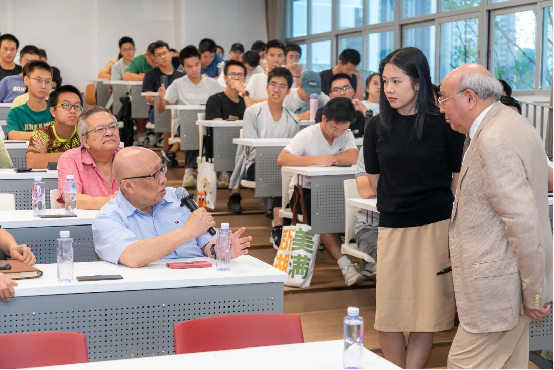
In addition, the discussion between Professor Akaev and Zhao Wei, Director of the SUAT Academic Committee, on how the development of artificial intelligence can narrow the wealth gap and achieve common prosperity also filled Li Honghao withanticipation and passion for future studies—
"While learning digital knowledge, we must also be aware of social responsibility and technical ethics issues, such as finding ways for human-machine coexistence and ensuring data security. Professor Akaev reminded us to keep learning, and under SUAT's interdisciplinary cultivation model, become outstanding scientists, excellent engineers, and distinguished entrepreneurs who solve problems of the new era. "
First-year undergraduate studentZheng Shuotong also expressed deep resonance—
"I deeply realize that China is entering a golden period that influences the world, where the integration of nanotechnology, information, and biotechnology—particularly the core role of computer technology and robotics in the digital economy—not only promotes international exchanges and cooperation but also drives technological progress and capital accumulation. Technological progress has become the key driving force for economic development, and future economics will rely more on information variables. On the other hand, robots do not require daily consumption like clothing and food, replacing humans to a certain extent, which motivates us to cherish educational opportunities, continuously climb in the field of science and technology, and achieve accomplishments. "
Professor Akaev stated that reform and opening up is a great policy that has enabled China's economy to develop rapidly. Under the leadership of General Secretary Xi Jinping, China has achieved comprehensive poverty alleviation, which is incredible and demonstrates that the path of socialism with Chinese characteristics is correct. In the current rising period of China's digital economy, SUAT's "AI+" education model is advanced, as it has proactively planned for multiple future-oriented fields, including life health and chip technology.
Professor Akaev also reminded students
↓↓↓
that while digital technology promotes economic growth, improves productivity, and reduces waste, we should also be aware of the replacement of human labor by robotic labor. He stated that pursuing economic growth alone without considering human factors is not a good economic development model. He encouraged everyone that, as the new generation, they should possess a spirit of continuous learning, pursue higher levels of education, and make beneficial explorations in "technology and humanity coexisting and growing together."

 CN
CN