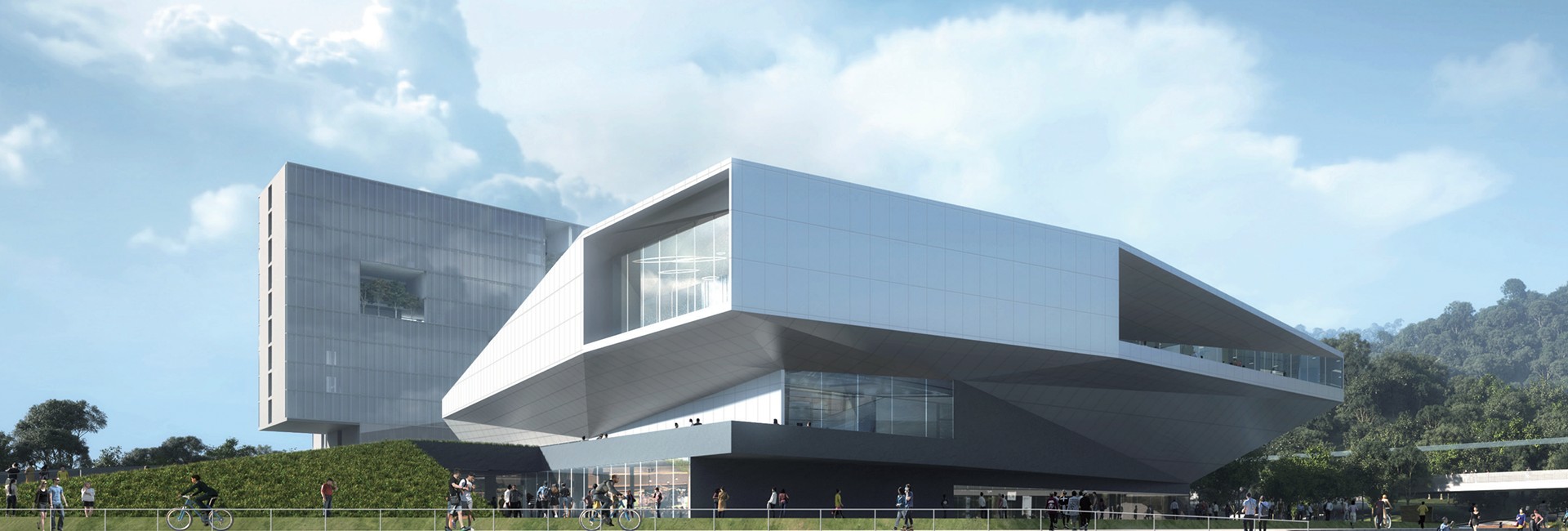
"Maybe the next Nobel Prize is at SUAT—who knows? "
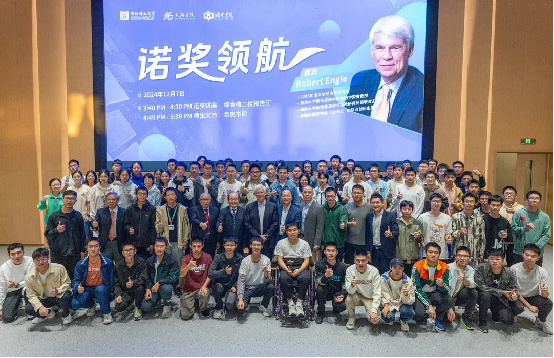
On December 7, first-year undergraduate Xiao Yilang at Shenzhen University of Advanced Technology (SUAT) boldly envisioned the future after face-to-face communication with 2003 Nobel Prize in Economics winner and renowned econometrician Robert Engle. In his view, to cultivate top scientists, one must first see top scientists—see what they are like, how they think, and how they do things. "The university gave us this opportunity to see the demeanor of Nobel laureates. "
Duration: 01:50
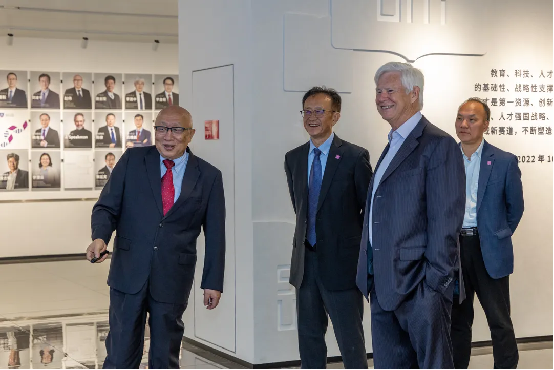
That afternoon, Robert Engle visited SUAT, accompanied by Party Secretary Zhu Dijian and President Fan Jianping, learning about the university's educational characteristics, cultivation model, faculty strength, college settings, residential college situation, etc.Robert Engle strongly agreed with SUAT's talent cultivation philosophy, especially emphasizing undergraduate education and allowing undergraduates to participate in research practice.

Throughout the rest of the afternoon
Robert Engle's time
was entirely reserved for SUAT students
especially the first-year undergraduates
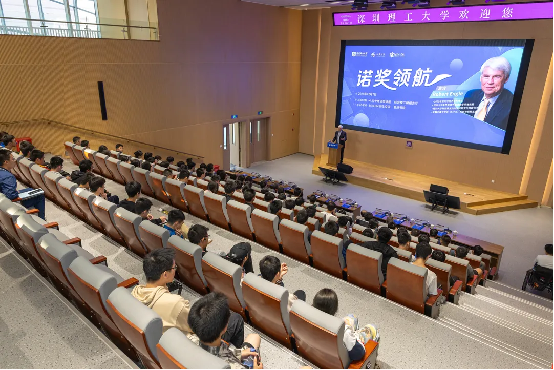
Robert Engle first delivered a lecture to students,combining economic principles with current hot topics to analyze the origins, risks, and coping strategies of climate change. He pointed out that from an economic perspective, the essence of climate issues is the spillover effects caused by carbon emissions from energy use, particularly emphasizing the impact of global climate change on the economic field and the importance of international cooperation.
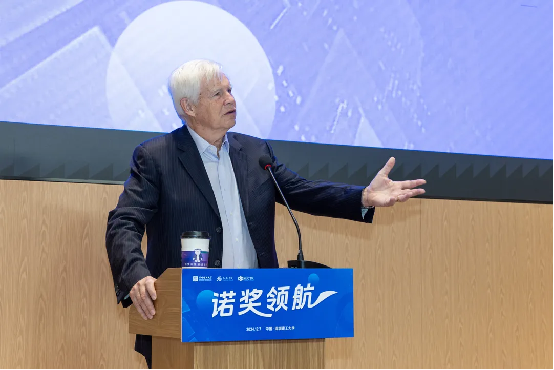
Hearing Robert Engle's discussion in the lecture on "countries should move from competition to cooperation," Xiao Yilang was somewhat puzzled because he noticed that at world-level environmental conferences, such as the recent 29th United Nations Climate Change Conference, developed and developing countries find it difficult to reach consensus on environmental protection plans. "If everyone pursues interests without taking responsibility, why hold such international conferences? "
"Because we don't want to wait until 2049 when environmental problems are already irreversible. " Robert Engle replied. From his answer, Xiao Yilang"gained a glimpse into the broad-mindedness and vision of scientific masters,"because "they are genuinely planning for humanity and humanity's future."
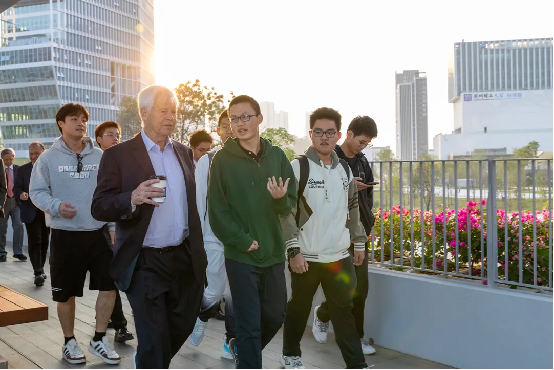
After the lecture
Robert Engle together with students
strolled around the SUAT campus
walking to Yuan Geng College
continuing face-to-face
discussions and exchanges with SUAT undergraduates
Along the way
students gathered around him
either introducing the university
or asking for advice and exchanging ideas
with laughter heard from time to time
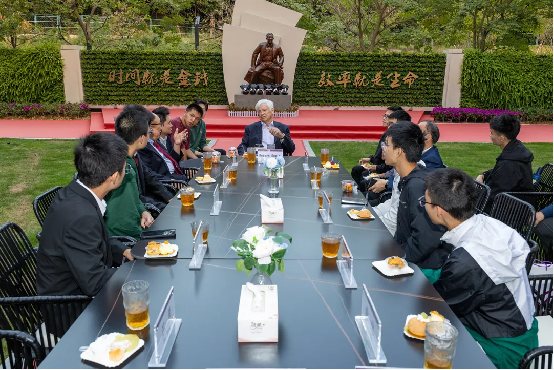
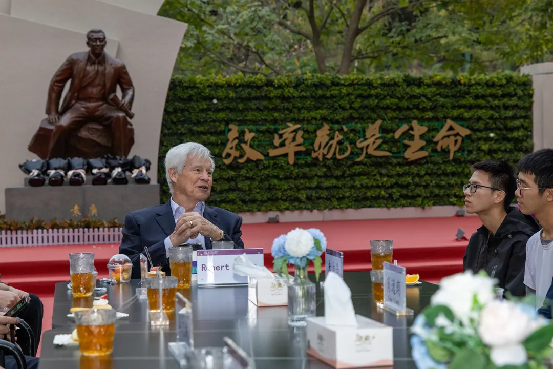
Upon arriving at the college, students and Professor Engle had tea and exchanged ideas; Robert Engle answered students' questions on climate change, economic modeling, interdisciplinary thinking, and other aspects in easy-to-understand language, andencouraged them to dare to challenge themselves and bravely explore unknown fields.
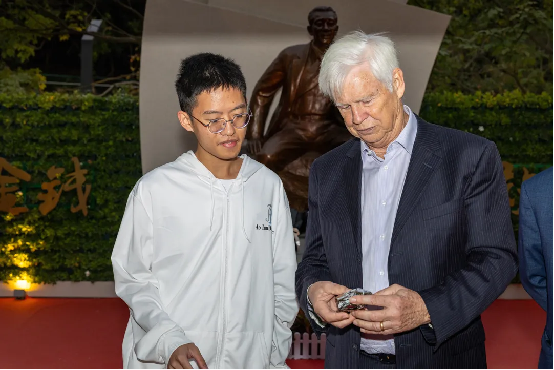
▲ Student representatives presented Robert Engle with a stone embedded with black phosphorus, symbolizing the university's spirit of bravely scaling technological peaks, daring to venture and try, and throwing stones to find the way
Regarding the four ways Robert Engle mentioned in the lecture to address climate change, first-year undergraduate Li Zhicheng said he had some understanding before but never so systematically. So during the discussion, he continued to ask Robert Engle: "Is humanity's preparation for climate change still insufficient? Has it not yet realized its severity? " Robert Engle provided detailed answers.
"Very happy to have this opportunity for face-to-face exchange with a Nobel laureate. " Li Zhicheng said. In fact, this is the common feeling of every student who participated in the lecture and discussion.
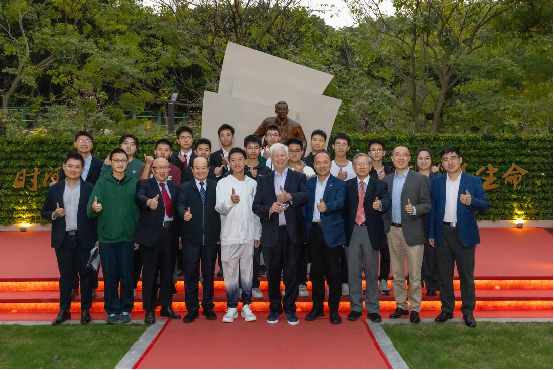
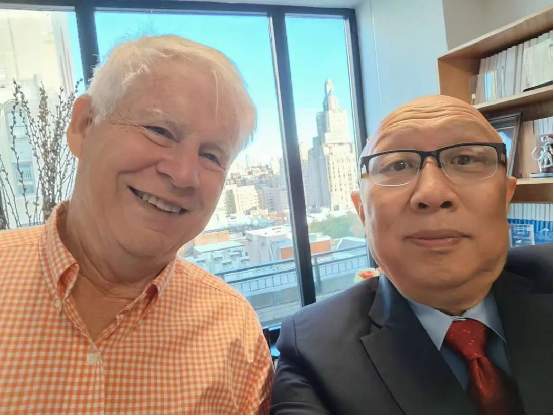
What everyone doesn't know is that as early as mid-November this year, to invite Robert Engle, Provost Zhao Wei specially flew to New York, USA, entered Robert Engle's office, and extended the invitation in person. Zhao Wei told Engle that SUAT attaches great importance to undergraduate education, hoping his knowledge and experiences can bring students broader vision and interdisciplinary abilities, and also hoping to create more opportunities for students to have close face-to-face contact with masters; Engle gladly accepted SUAT's invitation.
Andthis is already the second Nobel laureate to visit SUAT in over a month; the first was German physicist and 2014 Nobel Prize in Chemistry winner Stefan Hell, who came on November 2. Without exception, every time a master visits, SUAT emphasizes arranging face-to-face exchanges with undergraduates.
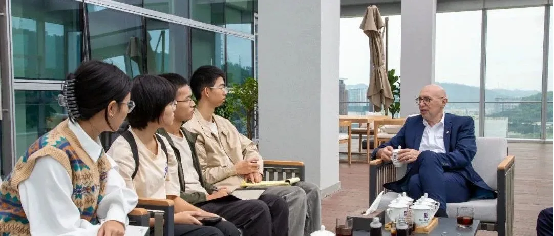
▲ Click the image to review
SUAT attaches great importance to undergraduate education; here, masters not only "teach" students on stage but also "befriend" students off stage.Students can engage in equal dialogue and interaction with masters, sharing glory and joy, learning and researching together, no longer "admiring" their "great achievements" from afar but exploring the secrets, hardships, and joys of their success up close and without blind spots, using the power of role models to increase students' confidence in success.
In the future, SUATwill continue to invite Turing Award winners and world champions to visit and exchange, providing more opportunities for students to have face-to-face communication and learning with them, cultivating top innovative talents with an international vision.
Some Students' Exchange Feelings

I'm very glad I applied to SUAT; these months have been very fulfilling, and here I've gained many unimaginable opportunities. Today, I asked Professor Engle some questions about mathematical modeling; he encouraged us to actively challenge solving problems with different methods and find better ones through continuous attempts. I believe this mindset he conveyed is equally applicable when facing difficulties and challenges in the future, encouraging me to continuously explore and progress.
— Yuan Geng College Ye Gulin
Professor Engle's broad vision made me realize that learning should not be confined to one corner; one should broaden their horizons to boldly innovate in their field and lead the way.
— Yuan Geng College Yuan Mingqian
In the exchange with the professor, I deeply felt his sense of responsibility and broad-mindedness as a scientist. As an economist, he not only concerns himself with global warming but also provides unique explanations and contributions to global climate change issues from an economic perspective, combined with his research direction. In addition, he particularly emphasized hoping we can work together to address this global challenge.
— Yuan Geng College Wu Yanqiao
I asked Professor Engle whether ideas from econometric models can be borrowed for risk assessment and decision support in the low-altitude economy, which requires real-time processing of large amounts of data. He encouraged us to explore in this area, looking forward to someone among us winning a Nobel Prize. I felt the magnitude of our planet's climate change challenges and the great responsibility on our shoulders, which further strengthened my confidence in broad learning and innovation, serving the country with science and technology, and benefiting the world.
— Dawning College Wu Zipeng
This contact with Professor Engle gave me a clearer direction for my efforts in the next four years of university: my learning and research should be more beneficial to others and society.
— Dawning College Zhang Zhishen
Midterms just ended, gaining temporary leisure,
Nobel guests full of joyful words.
Economy and climate full of changes,
Carbon neutrality strategies carefully discussed.
Discussing ancient and modern, understanding stock markets,
Talking freely about worldly affairs.
Do not say years are always peaceful,
Sudden clouds rise over distant peaks.
— Dawning College Li Zhicheng
Profile
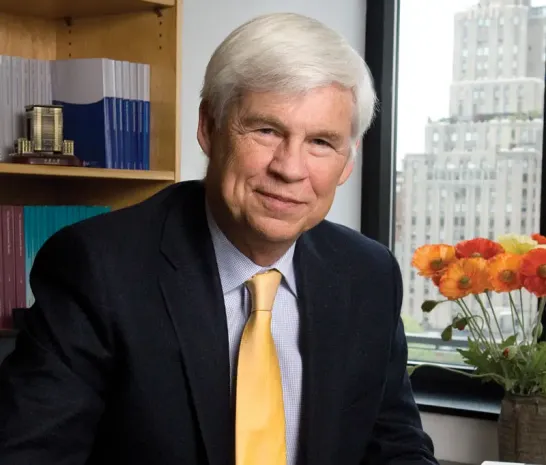
Robert Engle, renowned American econometrician. His created ARCH model has interdisciplinary contributions in economics, finance, statistics, and other fields. In 2003, for this pioneering work, Engle was awarded the Nobel Prize in Economics. Engle's important original research achievements in econometrics also include cointegration models, ACD models, CAViaR models, and DCC models. He has been elected as a Fellow of the Econometric Society, American Academy of Arts and Sciences, American Statistical Association, American Finance Association, United States National Academy of Sciences, and World Economic Forum. In addition, he has received honorary doctorates from institutions such as HEC Paris,University of Savoie Mont Blanc (France), and University of Italian Switzerland.
 CN
CN