ACS Nano | Shenzhen University of Advanced Technology Achieves the Most Stable Red-Light Emission!
What are metal halide perovskites?
Metal halide perovskites are a new generation of star semiconductor materials. As light-emitting layer materials in LEDs, they possess high carrier mobility, high color purity, and wide color gamut. Pure red perovskite LEDs, as one of the three primary colors, have great potential in future high-definition displays with bright prospects, but currently face challenges in balancing brightness and efficiency.
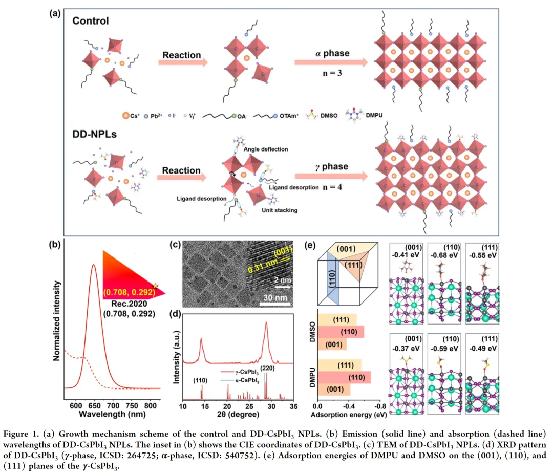
Recently, the team led byAcademician Cheng Huiming, Bai Yang, and Haoran Wang from Shenzhen University of Advanced Technology published in the top journalACS Nano, successfully preparing ultra-stable, high-performance pure-red γ-CsPbI3 nanoplatelets and developing excellent red LED devices that precisely match the highest display standard (Rec.2020) of the International Commission on Illumination (CIE).
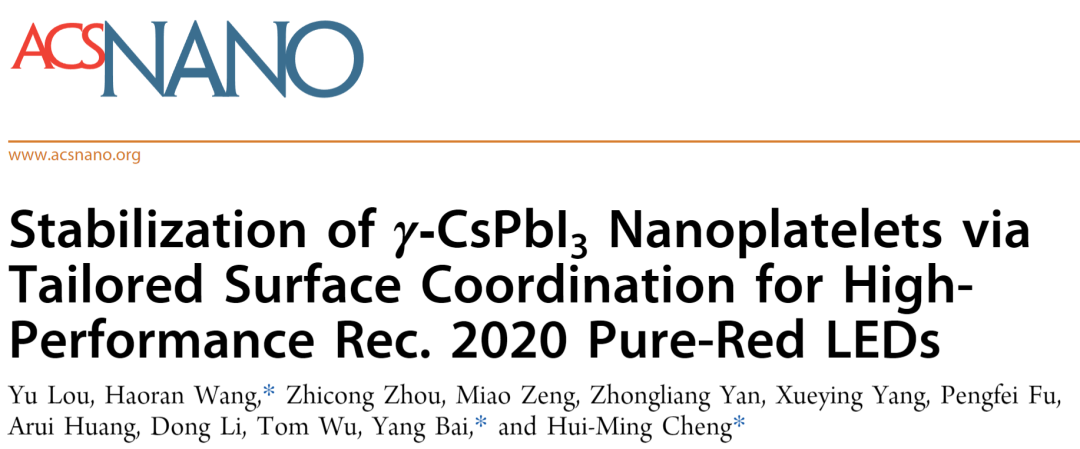
Screenshot of the published article
This study provides a new approach to solving the stability and efficiency challenges of pure red perovskite materials and lays the critical material foundation for next-generation ultra-high-definition, wide-color-gamut display technology.
The team targeted the highly promising luminescent material —CsPbI₃ nanoplatelets. They inherently possess the potential to emit ideal pure red light (wavelength ~646 nm), but their optically active cubic phase (black phase) is unstable at room temperature and readily collapses into a non-emissive yellow phase, rendering them useless for applications. Among the three black phases (α, β, γ), the γ-phase has the lowest formation energy and the lowest surface free energy, making it the most thermodynamically stable perovskite phase at room temperature. However, its direct formation is difficult due to hard-to-control crystallization kinetics.
The team took an innovative approach, cleverly employing two special “molecular tools” (ligands) — dimethyl sulfoxide (DMSO) and N, N’-dimethylpropyleneurea (DMPU) — via a synergistic dual-ligand surface coordination strategy to precisely control the growth of γ-CsPbI₃ nanoplatelets (NPLs). The dual-ligand synergy not only achieved outstanding structural stability but also effectively passivated surface defects, enabling highly efficient conversion of energy into pure red light.
The γ-CsPbI₃ nanoplatelets prepared by this novel method exhibit remarkable performance:
1
Near-perfect luminescence efficiency: Photoluminescence quantum yield (PLQY) approaching 100% — nearly all absorbed photons are converted into pure red light with minimal loss.
2
Exceptional thermal and photostability: Maintains intense photoluminescence even under prolonged 405 nm laser irradiation at 80 °C.
Leveraging these advantages, the fabricated color-stable perovskite LEDs achieved a record external quantum efficiency of 12.43% for CsPbI₃nanoplatelets -based devices — the highest reported to date.
This breakthrough goes beyond the lab — it could transform daily life and pave the way for next-generation high-definition displays. For example, it will deliver purer, more vivid, and more stable pure-red emission for phones, TVs, and VR/AR devices, dramatically enhancing visual experience; provide high-performance, long-lifetime red light sources for specialty lighting and signaling; and offer fresh ideas and powerful tools for developing other high-performance, ultra-stable functional materials (optoelectronics, catalysts, etc.) (click “Read more” at the end of the article for paper details).
 CN
CN