Previously, like many others, first-year undergraduate student Huang Shaoheng at Shenzhen University of Advanced Technology(SUAT) often felt confused when facing many choices in life. However, after face-to-face communication with Turing Award winner John Hopcroft, he suddenly felt enlightened. Because John Hopcroft told him to first ask himself what he is most interested in and then fully commit to it.
"Finding the right interest point is crucial. " Huang Shaoheng said that clarifying the direction makes energy investment valuable, allowing one to gain motivation and satisfaction in pursuit, making life fulfilling and meaningful.
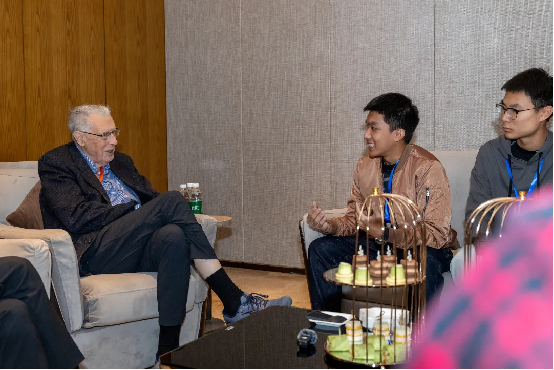
Huang Shaoheng Communicating with Turing Award Winner John Hopcroft
Shenzhen University of Advanced Technology (SUAT)
Likes: 94
On December 14, Turing Award winner John Hopcroft was invited to attend the Second Greater Bay Area University Computer Science College Deans (Department Chairs) Forum hosted by SUAT. Provost Zhao Wei and Dean Pan Yi of the Faculty of Computing Science and Control Engineering specially communicated with him to secure one and a half hours during the forum break for face-to-face discussions with SUAT first-year students.
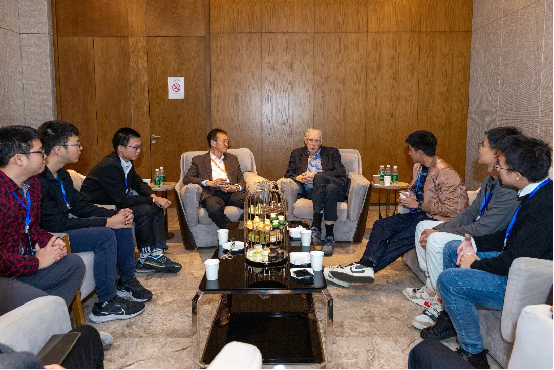

John Hopcroft is a world-renowned theoretical computer scientist who proposed the"worst-case asymptotic analysis method for algorithms," establishing objective criteria for judging algorithm efficiency and quality for the first time, becoming the "gold standard" for evaluating algorithm performance. In 1986, he won the highest honor in computer science research—the "Turing Award"—for his"foundational achievements in the design and analysis of algorithms and data structures," an award known as the "Nobel Prize of Computing."
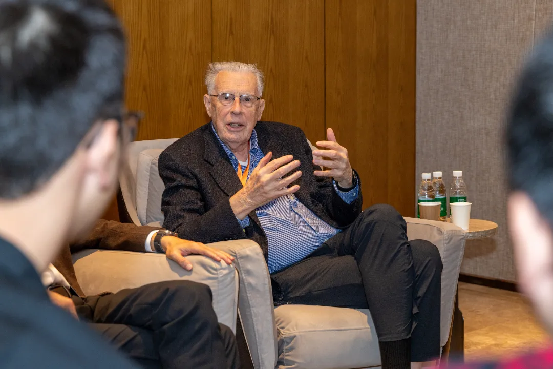
In fact
Just as he told Huang Shaoheng to follow interests
John Hopcroft himself has always followed his interests
to achieve later accomplishments

"Professor Hopcroft told me that he majored in electrical engineering as an undergraduate, when there was not even a computer science major; he was just doing what interested him. " said first-year undergraduate student Li Honghao from SUAT. Later, he thought time complexity was very suitable for describing the efficiency of computer algorithms, so he integrated these theories and gave a report, not knowing at the time how important it would be in the future,"because he was just doing what interested him.”
Therefore, when talking about his achievements, John Hopcroft frankly said "this was an accident."
"This made me reflect that blindly improving hard skills and stubbornly pursuing achievements may instead make it difficult to achieve them. " Li Honghao said, as Professor Hopcroft said, cultivating soft skills, finding a field one enjoys and deeply cultivating it, perhaps one day breakthrough results will "unexpectedly" appear. "This also reminds me of the university's research rotation program; isn't it set up precisely to help us find the research direction we love and cultivate soft skills?I believe that through practice, everyone can cultivate soft skills such as hands-on ability, communication skills, and leadership, discover the field they truly love, cultivate it deeply, and ultimately contribute to scientific research. "
Over the past month, in addition to John Hopcroft, the masters who have had in-depth face-to-face exchanges with undergraduates include two Nobel laureates: German physicist and 2014 Nobel Prize in Chemistry winner Stefan Hell, and 2003 Nobel Prize in Economics winner and famous econometrician Robert Engle.Each time, SUAT reserves most of these masters' time for undergraduates, allowing them to engage in equal dialogue and interaction, sharing glory and joy, learning and researching together, making role models become "friends."
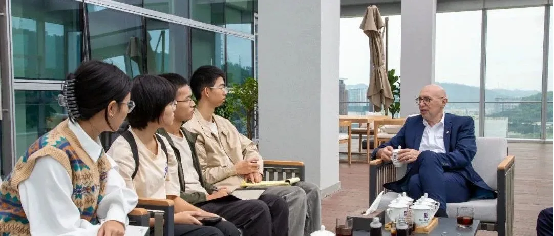 Click the image to review
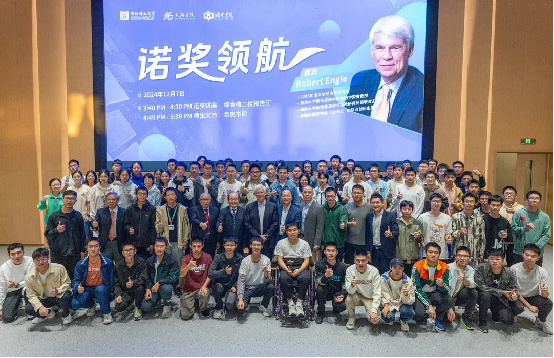 Click the image to review
In the future, SUAT will continue to invite more masters to visit and exchange, providing students with more opportunities for face-to-face communication and learning, cultivating top innovative talents with an international vision.
Some Students' Exchange Feelings
I asked Professor Hopcroft, as a first-year student, how I should balance learning the foundational theories of computer science with solving practical problems in the field. The professor first asked if I really wanted to solve problems or was forced to, then explained to me that interests and hobbies are the inexhaustible driving force guiding us forward in different fields; we do not need to think about how to balance them; we should find the direction we are interested in as our goal and strive for it. As Professor Hopcroft said: “We only have one life to live, so find what you enjoy and don't waste your time. "We should be guided by interests, reduce our utilitarian mindset, and shine in the field we are interested in.
— First-Year Undergraduate Liu Junxi
I asked Professor Hopcroft whether current students still need to learn some outdated theories and algorithms in computer science. The professor said that there are many possibilities in the future; just as many students in the United States now completely use machines to write code, he does not know whether in the future we will use the algorithms or theories that their generation spent over a decade developing, so this requires us to explore ourselves. After listening to the professor, I feel that doing what the heart loves allows no regrets; doing what the mind thinks about day and night leads to achievements; doing what the soul yearns for makes life worthwhile; doing what the feet firmly step toward reaches the distance. Seek non-utilitarianism, cultivate soft skills. Persistently pursue passion, live wonderfully.
— First-Year Undergraduate Huang Tao
In fact, Professor Hopcroft's choice of computer science major at the time was also a coincidence, and he happened to become a pioneer in this field. This also shows that many decisions and choices on the academic path are accidental. However, no matter what accidents occur on the academic path, we should accept them; no matter what major we choose, as long as we work hard, it is very likely to achieve loving what we do, turning the major into our interest, and even possibly achieving success in this field. In other words, we should not overly dwell on whether a choice is right or wrong, as it only represents temporary success or failure. What we truly need to focus more on is whether we have continuous forward momentum on the research path; as long as there are passion and drive, this is more important than anything else. This is the inspiration the professor gave me.
— First-Year Undergraduate Li Zhicheng
I once always believed that the core of mathematics lies in proficient use of formulas and concepts, but Professor Hopcroft told me that many times, mathematical formulas cannot help us understand computer science more deeply. We may learn many formulas in class but find them difficult to apply in practice. Therefore, learning mathematics does not greatly help us understand a science. Many times, it is the change in thinking brought by learning mathematics that helps us understand computer science, such as learning division helping us understand fractions. Therefore, the change in thinking brought by mathematics is more important than a pile of formulas. This gives us intuition to know what is right and what is wrong in an algorithm. The professor's answer changed my view of mathematics, so in the future, I will pay more attention to improving mathematical literacy in daily learning, abandon the high school question-brushing mindset, put more energy into the logic and thinking behind proofs, and seriously absorb the essence of each theory.
— First-Year Undergraduate Shen Weijian
 CN
CN